Author: the other food interpreter

Cream of cauliflower soup with truffle oil

For an engineered plant, cauliflower looks distinguishably primeval, the stuff dinosaurs would graze. Same as the truffles that combine very well in this soup, that even people who cannot stand the smell of cauliflower enjoy. 1 medium cauliflower (about 700g), stalks removed and cut into florets 1,5 l chicken or vegetable stock 100g parmesan cheese, grated 300ml whipping cream 30ml white truffle infused oil sea salt and freshly ground black pepper Serves 6 In a large saucepan add the cauliflower florets and the stock. Bring to a boil, then lower the temperature and let simmer uncovered for 1 hour. Add the grated parmesan and the cream and bring to a boil. Using a stick blender, puree the soup directly in the saucepan until it is very smooth and creamy. Add the truffle oil, season with salt and pepper and bring to simmer. When ready to serve, reheat the soup gently.

Chocolate Fondant Tart

How did the chocolate Montezuma drank taste like? After a day on the temple, did he sip his chocolate ‘all frothed up’ and plan following’s day ritual sacrifices ? Chocolate was one of the oddities the Spanish conquistadores encountered in the Court of the Aztec Emperor. Cortez loved chocolate, and reported back home to Charles V about the ‘divine drink’. Spaniards however were not convinced at first – it was probably too bitter-, but after some attempts involving wine and spices soon mixed it with sugar, vanilla and milk and chocolate took off, making its way to other Habsburg territories and beyond. Fast-forward 500 years and a completely different setting.  A dessert developed to be eaten in warm bourgeois (Salzburgian) houses of central Europe: Chocolate tart. Chocolate had been tamed for much of its european trajectory – too sweet, too much vanilla (extract) and milk. In the last decades chocolate desserts became more bitter and dark, closer to the original spirit of ‘xocolatl’. For the pastry 150g softened butter, cubed 3 Tbsp lukewarm water 250g  all purpose flour 4 egg yolks 1 pinch …

Aromatic Chicken Pie

Some time ago we decided to cook the traditional moroccan bastilla. We tried out several versions, and in a while  drifted away to our version of chicken pie. We cooked it with dates or sultanas, with chicken livers or not, with hard boiled eggs or scrambled in chicken stock, almonds or pine-nuts – depending on what we had in the fridge and pantry. We settled on the following recipe, for individual or bigger pies. It references to the original moroccan pie in the sense that we kept the sugar and cinnamon on top. This is a simple but time-consuming recipe and everybody loves it. Makes 6 individual pies 1 whole chicken, cut into 8 pieces 4 Tbsp extra virgin olive oil 1 kg onions, diced 2 Tbsp finely grated fresh ginger 1 tsp ground cinnamon, plus 1/2 tsp extra for dusting 1/2 tsp ground nutmeg 1/2 tsp ground turmeric 1/2 tsp ground mace a pinch of saffron threads 400 ml warm chicken stock or water 10 dates, pitted and finely chopped 80g pine nuts, toasted 20g  fresh coriander, …

Pizza at Home

I took the pizza topping test in the internet, and it turns out “I may be a little different than everyone else, but I am  still loved by many”. On top of that, the test says “You Are Pineapple” . I probably should not have chosen San Francisco to go if I won a trip. Seriously now, the topping in this recipe is loved by all (instead of by many). We use Gruyère from Naxos, but you can substitute it with any good quality Gruyère. Makes 4 round pizzas ø 38cm For the dough 500g strong white flour, plus extra for dusting 1 handful wholewheat flour 20g fresh yeast ½ tsp brown sugar 300ml lukewarm water 50ml extra virgin olive oil, plus extra for greasing 2 tsp salt 80g semolina A day before you want to make the pizza combine both flours in the bowl of a mixer. Make a well in the middle, crumble in the yeast and add the sugar and 100ml lukewarm water. Mix a little of the flour into the  mixture and leave to rest for 15 minutes. Then add the oil, salt …

Jam Tartlets

We always have some leftover pastry dough in our freezer after baking tarts. This is our favorite way to use it. Roll out the leftover pastry on a lightly floured surface until approximately 3mm thick. Cut circular shapes with a cookie cutter . Put each circle to a cupcake tin, lined with paper cases. Refrigerate for 15 minutes. Preheat the oven to 180ºC. Add a teaspoon of jam or marmalade -we use orange marmalade or plum jam- to each case and bake for about 10 minutes.

Scones in the Summertime

We returned to our house by the sea in Naxos after several years – this time with an extra member. We had to come up with a new eating-and-cooking routine, given also the fact that we entertained friends almost daily (or nightly). It had to be easy, fast and secure: cheese pies, scones, chocolate cakes, tzatziki, salads and of course lots  of local cheese, figs and watermelons. For drinks Greek white wines (asyrtiko for the French friends who value terroire) and gin with tonic and lots of ice cubes. Whenever we ran out of cucumbers for the mix, because we put them all in the salad, we used watermelon – they both belong to the cucurbitaceae family. We unpacked kitchenware and put the old stove into use, so we had to adjust cooking and baking times and temperatures. Scones were a success for breakfast, and we had them -unconventionally-  with some local cheese (graviera and xinotyri) or with our homemade apricot jam.  Here is our standard scone recipe, adapted from the cookbook of Rose Carrarini, …

Chocolate mousse with olive oil

We are Greeks and we put olive oil into anything. For this recipe we use high quality chocolate and unripe extra virgin oil, but if it is too intense for your tastes, skip the ‘unripe’ part which gives a distinct fruitiness to the result. It’s a rather uncomplicated recipe, unless you have a toddler who wants to participate in every step. Adapted from a recipe by Stelios Parliaros. Serves 4-5 200g good quality dark chocolate  (66% cocoa solids) 40g extra virgin olive oil 4 egg yolks 4 egg whites 50g caster sugar 2 Tbsp brandy Break the chocolate into small pieces and drop into a bowl with the olive oil. Fill a small saucepan about a quarter full with hot water, then sit the bowl on top so it rests on the rim of the pan, not touching the water. Put over a low heat until the chocolate has melted, stirring occasionally to mix with the olive oil.Remove the bowl from the pan. Cool slightly. Beat the egg yolks with the brandy until pale yellow. Whisk in the …

Fennel and crumble gratin

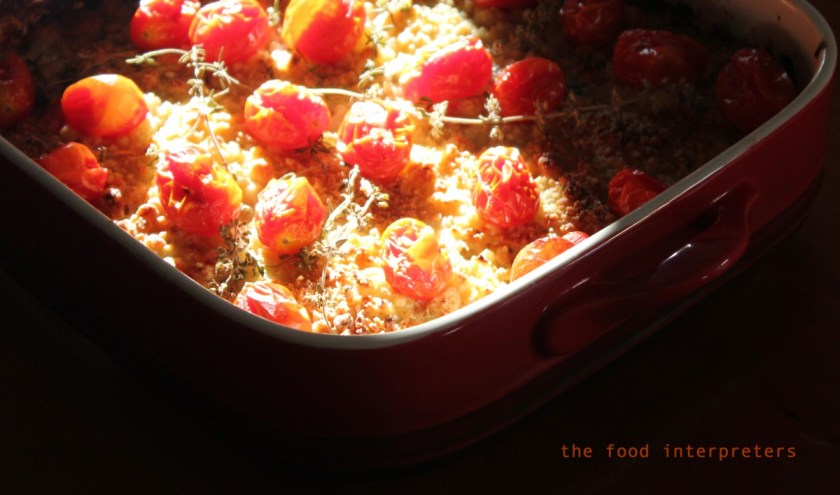
This is an unusual combination of Mediterranean ingredients with British resourcefulness, facilitated by an Israeli chef. Fennel is a Mediterranean plant, attested in Mycenaean Linear B tablets as ma-ra-tu-wo (it is still called marathos in Greek). Linear B was used by professional scribes for administrative purposes – we know that fennel was stocked or traded in Mycenaean palaces in the late bronze age (Helen of Troy enjoying fennel with honey?). Fennel was introduced in the British Isles probably by the Romans. It is mentioned together with thyme, another ingredient of this recipe, in the pagan “Nine Herb Charm”, intended to treat poisoning and infection. Crumble toppings became popular in the UK during WWII, as an economical alternative to pies due to shortages of ingredients as a result of rationing. (Despite its humble and rustic associations it crossed the channel and became popular with the french). These two different ‘streams’ come together in this recipe of Ottolenghi , with some dissonance, because of the sugar in the crumble. You can have it cold or warm, as a starter or as a …

Quiche Lorraine

This quiche Lorraine is ambiguous: thought to be as French as Edith Piaf, its origin and name (related to the german Kuchen) is German.  Regarded an easy dish, this version is anything but. It is based on the recipe found in the book ‘Heston Blumenthal at Home’ which makes it by definition challenging to execute. But do not be discouraged, it will be an instant hit at your dinner parties. Plus it can be prepared a day in advance as this helps the custard filling to set properly. For the best flavour, it should be served warm or at room temperature. Serves 6 or hungry 4. For the pastry 230g all purpose flour 1/2 tsp sea salt 100g cold unsalted butter, cubed 25g egg, lightly beaten (approx. 1/2 large egg) 40g cold tap water For the filling 40g unsalted butter 4 large onions, peeled  and finely sliced 200g bacon lardons 3 large eggs 300g whipping cream 80g grated gruyère cheese 20g grated parmesan cheese sea salt and freshly ground black pepper nutmeg For the pastry put …