Latest Posts

Parmesan Truffle Fries

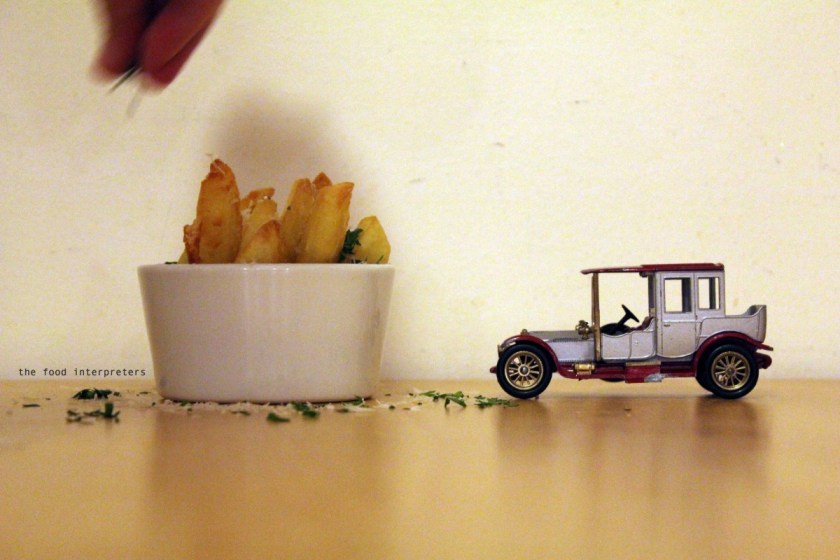
Triple cooked fries AND parmesan AND truffle oil. How much better can it get? This recipe is a hybrid: the fries recipe is adapted from the great invention of Blumenthal and the parmesan and truffle toping is sort of Singaporean best practice. It is worth preparing much more than you think is enough; last time we served them, the dinner party turned to a small ordeal for the guests, trying to be polite and not grasp the last remaining fries.

  • 1.2kg potatoes
  • 1l olive oil
  • 1,5 Tbsp truffle oil
  • 2 Tbsp parmesan cheese,  finely grated
  • 1 Tbsp parsley, very finely copped
  • salt to taste

serves 4

Peel the potatoes and cut them into even-sized wedges. We usually get 6 or 8 wedges from each potato, depending on size. Place them in a bowl under running water for about 3 minutes to rinse off the starch.

Place the wedges in a saucepan filled with cold tap water. Bring to a boil and simmer until the potatoes are almost cooked, for about 7-8 minutes, depending on the potato. Gently drain the potatoes, place them in a roasting tin to dry out. Then shake the tin gently to rough up the edges and place in the fridge for about one hour.

fries9

Heat a deep-fat fryer or a deep saucepan, no more than half filled with the oil, to 130ºC. Fry the potatoes in small batches for 3-4 minutes until a light crust forms. Remove the fries from the oil and drain on kitchen paper. Leave to cool and place in the fridge again for at least one hour. (At this stage you can keep the fries in the fridge for 3 days.)

Heat the oil in the deep-fat fryer or deep saucepan to 180ºC and cook the fries in batches for 4-5 minutes until crisp and golden. Drain on kitchen paper.

tfries6

Transfer the fries to a serving bowl. Drizzle with the truffle oil. Then sprinkle with salt, grated parmesan cheese and parsley.

tfries3


Cream of cauliflower soup with truffle oil

For an engineered plant, cauliflower looks distinguishably primeval, the stuff dinosaurs would graze. Same as the truffles that combine very well in this soup, that even people who cannot stand the smell of cauliflower enjoy.

  • 1 medium cauliflower (about 700g), stalks removed and cut into florets
  • 1,5 l chicken or vegetable stock
  • 100g parmesan cheese, grated
  • 300ml whipping cream
  • 30ml white truffle infused oil
  • sea salt and freshly ground black pepper

Serves 6

In a large saucepan add the cauliflower florets and the stock. Bring to a boil, then lower the temperature and let simmer uncovered for 1 hour.

Add the grated parmesan and the cream and bring to a boil. Using a stick blender, puree the soup directly in the saucepan until it is very smooth and creamy. Add the truffle oil, season with salt and pepper and bring to simmer.

When ready to serve, reheat the soup gently.

Chocolate Fondant Tart

How did the chocolate Montezuma drank taste like? After a day on the temple, did he sip his chocolate ‘all frothed up’ and plan following’s day ritual sacrifices ?

Chocolate was one of the oddities the Spanish conquistadores encountered in the Court of the Aztec Emperor.

Cortez loved chocolate, and reported back home to Charles V about the ‘divine drink’. Spaniards however were not convinced at first – it was probably too bitter-, but after some attempts involving wine and spices soon mixed it with sugar, vanilla and milk and chocolate took off, making its way to other Habsburg territories and beyond.

Fast-forward 500 years and a completely different setting.  A dessert developed to be eaten in warm bourgeois (Salzburgian) houses of central Europe: Chocolate tart. Chocolate had been tamed for much of its european trajectory – too sweet, too much vanilla (extract) and milk. In the last decades chocolate desserts became more bitter and dark, closer to the original spirit of ‘xocolatl’.

For the pastry

  • 150g softened butter, cubed
  • 3 Tbsp lukewarm water
  • 250g  all purpose flour
  • 4 egg yolks
  • 1 pinch sea salt

For the chocolate filling

  • 300g  good quality dark chocolate  (66% cocoa solids)
  • 2 eggs
  • 350ml heavy cream
  • 150ml milk

For the pastry put the flour, salt and butter in a mixer fitted with the paddle attachment and combine until the mixture resembles breadcrumbs. Change to the hook attachment and add the lukewarm water and the egg yolks. Continue mixing until dough comes together to form a ball. Shape the dough into a disc, wrap in clingfilm and refrigerate for 30 minutes.

Remove the pastry from the refrigerator and roll out on a lightly floured surface until approximately 3mm thick.

Butter a 23cm fluted tart tin (with removable bottom, if you have one), line with the pastry and gently push it into the base and edges,allowing the excess to hang  by 1cm over the sides.* Prick all over the base of the tart with a fork and refrigerate for 30 minutes.

Preheat the oven to 170°C.

Cut a large circle of baking parchment and scrunch it  up a couple of times. Lay it over the pastry base, fill with beans or coins and bake for approximately 20 minutes before removing the beans or coins and parchment. Return the pastry case  to the oven and bake for a further 5 minutes. Remove the tart tin from the oven, let cool a little and then, using a sharp knife, cut the excess pastry from around the top of the tart tin.

Reduce the oven temperature to 160ºC.

Chop the chocolate into small pieces. Pour the cream and milk into a saucepan and slowly bring to a boil over medium heat stirring constantly. When it begins to bubble, remove from the heat and add the chocolate. Whisk well until the mixture is perfectly smooth. Cool slightly.

Beat the whole eggs, then add them to the chocolate mixture, whisking energetically to prevent the eggs from cooking.

Pour the chocolate mixture into the tart shell and bake for 18 minutes. The filling should be set, but still wobbly in the centre.

* I usually store the leftover dough in a plastic wrap in the freezer for later use.


Extra Virgin Green Olive Oil, cold pressed

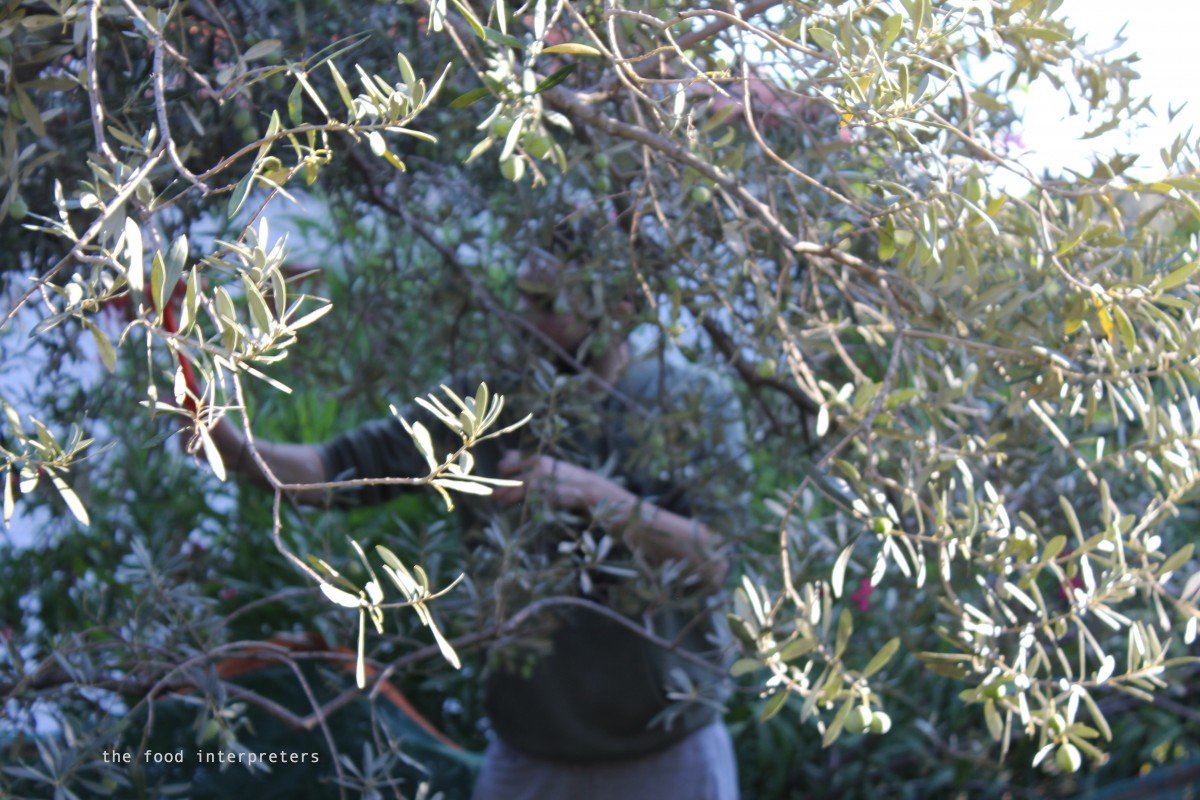
Every autumn Popi recruits workers, volunteers  and semi-volunteers to harvest the olives. When it comes to olive oil she is a perfectionist. The green olives have to be combed down from the trees gently, inspected one-by-one and carried to the oil press within a strict schedule. Luckily for all in the last years she has settled for one of the presses half an hour drive away, a big improvement over the long drives of the past, when she had confronted and discarded every facility in the prefecture.

o5

o3

This year someone suggested to use harvest machines for speed. When we arrived the device was flat on the ground, Popi looking down to it in disgust and explaining that is was a really bad idea, the way it hurt the fruit. 

Popi goes around, inspecting how all are performing,  and explaining what great fun it is to gather the olives: ‘It is not at all tiring, only a great opportunity to exercise, and that only for the first day, then it is not even a challenge’. As sunset approaches she intensifies her rounds of disks full of meatballs and small cheese pies. It is time to pause and stare down the slope at all the autumn shades of green and blue, up to the sea.

o7

Then it is gathering the olives from the nets, discarding  what does not pass quality control and loading them to the track that brings them to the press. This year it all went smoothly.

o8.1Christos ready for the oil press

The last act is dinner. Young oil with salt and oregano on hot bread slices. Big trays from the oven, wine from Messogia and the first oranges of the season. Well done Popi.

o2Popi, dilettanti extraordinaire

Aromatic Chicken Pie

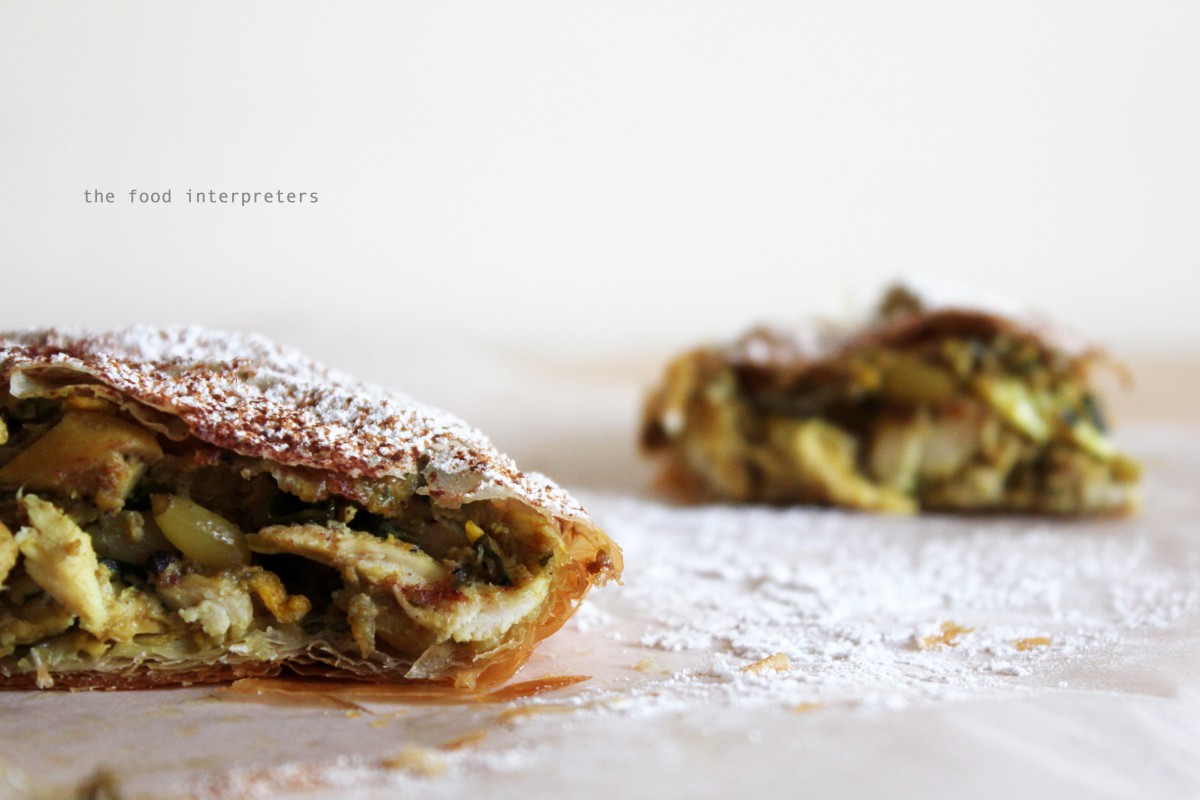
Some time ago we decided to cook the traditional moroccan bastilla. We tried out several versions, and in a while  drifted away to our version of chicken pie. We cooked it with dates or sultanas, with chicken livers or not, with hard boiled eggs or scrambled in chicken stock, almonds or pine-nuts – depending on what we had in the fridge and pantry. We settled on the following recipe, for individual or bigger pies. It references to the original moroccan pie in the sense that we kept the sugar and cinnamon on top.

moChP2Logo

This is a simple but time-consuming recipe and everybody loves it. Makes 6 individual pies

  • 1 whole chicken, cut into 8 pieces
  • 4 Tbsp extra virgin olive oil
  • 1 kg onions, diced
  • 2 Tbsp finely grated fresh ginger
  • 1 tsp ground cinnamon, plus 1/2 tsp extra for dusting
  • 1/2 tsp ground nutmeg
  • 1/2 tsp ground turmeric
  • 1/2 tsp ground mace
  • a pinch of saffron threads
  • 400 ml warm chicken stock or water
  • 10 dates, pitted and finely chopped
  • 80g pine nuts, toasted
  • 20g  fresh coriander, stalks and leaves finely chopped
  • 20g fresh parsley, stalks and leaves finely chopped
  • 5 eggs, lightly beaten
  • 1 Tbsp clear honey
  • Sea salt
  • Freshly ground black pepper
  • 250g filo pastry
  • 150g butter, melted
  • icing sugar for dusting

morCh4Log

Heat the oil in a heavy large saucepan over medium heat. Add the onion and cook stirring regularly for about 5-8 minutes, until it is soft and lightly golden. Mix in cinnamon, nutmeg, turmeric, mace and saffron and stir well for about 1 minute.

Add the chicken and cook, stirring for 2-3 minutes. Add the warm chicken stock or water and gently simmer uncovered for about 40 minutes or until the thigh meat is falling away from the bone. Stir in the dates and allow to cool down in the stock until chicken is cool enough to handle.

Strain through a sieve and pour the strained stock back into the pan. Take out the chicken,remove and discard the skin and bones and shred the meat into large pieces. Mix the chicken meat with the onions and set aside.

Meanwhile, bring the strained stock to the boil, until it has reduced to about 150ml. Reduce the heat and stir the beaten eggs into the hot liquid. It will look curdled, but don’t worry. Simmer for 5 mins, stirring constantly.Remove the saucepan from heat and pour the egg mixture into a coarse sieve set over a bowl. Let mixture drain undisturbed 10 minutes before discarding any liquid.

Toast the pine nuts in a large frying pan over a medium heat until golden brown (not burnt!).

Transfer the egg mixture into a bowl. Stir in the chicken and onion mixture, the toasted pine nuts, parsley and coriander. Add the honey and give everything a good mix. Season generously with salt and black pepper. Filling may be made 1 day ahead and kept chilled, covered.

Preheat the oven to 200°C ( if using fan 180°C).

Line a large baking tray with baking parchment.

Divide the filling into six portions.

Cut the filo sheets in half crosswise. On a work surface arrange the first half sheet of filo and brush it with the melted butter. Place the second half on top to create a star shape (more or less) and brush it with butter. Arrange one portion of the filling in the centre and pat it down to form a disc. Bring the points of the filo in towards the centre, brushing each one with the melted butter, to create a round pie.

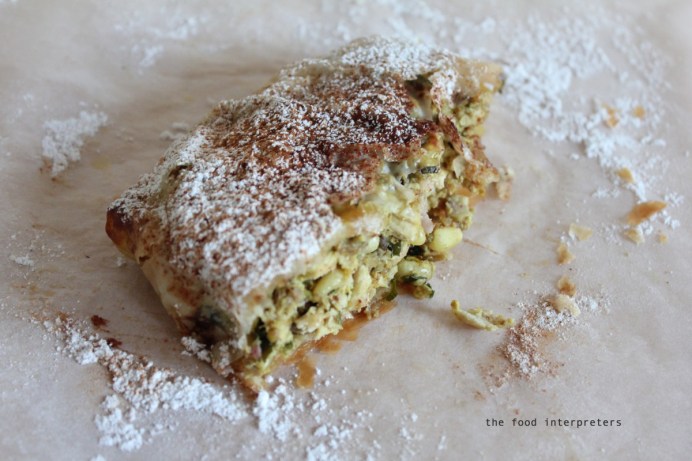
Turn the pie over and place it on the prepared baking tray. Repeat with the remaining filo sheets and filling to create five more pies. Brush the tops and sides of the pies with melted butter and bake for about 20 minutes, until golden brown. Dust with icing sugar and cinnamon and serve immediately.


Pizza at Home

I took the pizza topping test in the internet, and it turns out “I may be a little different than everyone else, but I am  still loved by many”. On top of that, the test says “You Are Pineapple” . I probably should not have chosen San Francisco to go if I won a trip.

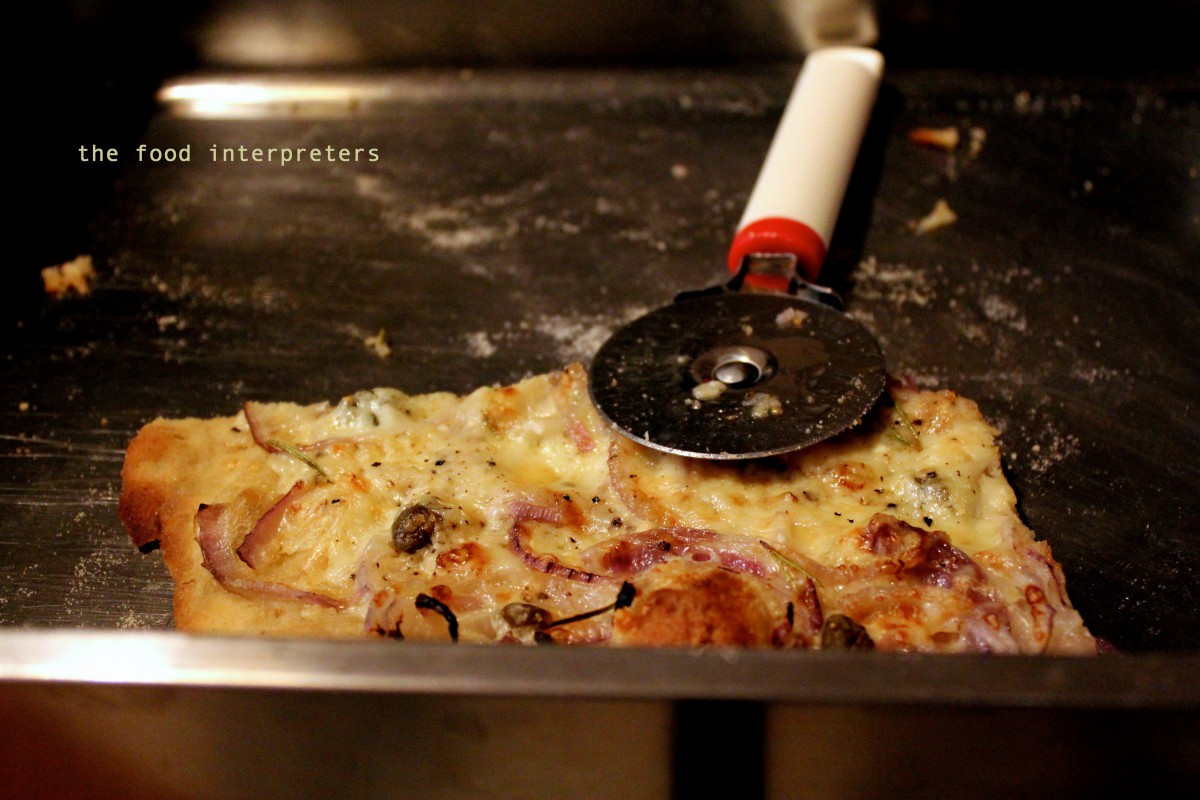
Seriously now, the topping in this recipe is loved by all (instead of by many). We use Gruyère from Naxos, but you can substitute it with any good quality Gruyère.

Makes 4 round pizzas ø 38cm

For the dough

  • 500g strong white flour, plus extra for dusting
  • 1 handful wholewheat flour
  • 20g fresh yeast
  • ½ tsp brown sugar
  • 300ml lukewarm water
  • 50ml extra virgin olive oil, plus extra for greasing
  • 2 tsp salt
  • 80g semolina

A day before you want to make the pizza combine both flours in the bowl of a mixer. Make a well in the middle, crumble in the yeast and add the sugar and 100ml lukewarm water. Mix a little of the flour into the  mixture and leave to rest for 15 minutes.

Then add the oil, salt and 200ml lukewarm water to the bowl. Mix well using the hook attachment of your mixer until a  smooth and soft dough forms. If necessary, add some more flour.

Divide your dough into four even pieces and form each one into a ball. Brush each ball with olive oil.Place each dough ball into an oiled bowl, cover with cling film and refrigerate overnight. The following day, take the dough out of the fridge and let it rise for about 1 hour.

(If you’re making the dough on the day, leave it in a warm place for about 1½ hours or until it has doubled in size.)

Place the pizza stone on the bottom rack of a cold oven and turn the oven to its highest temperature, about 240ºC. (If you do not use a pizza stone see the note at the end*.)

Dust the work surface with a mixture of flour and semolina and roll out each dough ball until it is about as big as your pizza stone.

Place the crust on a very well floured moveable, slick cutting board to help you transfer the pizza to the hot pizza stone once it is topped.

And now it’s time for the toppings!
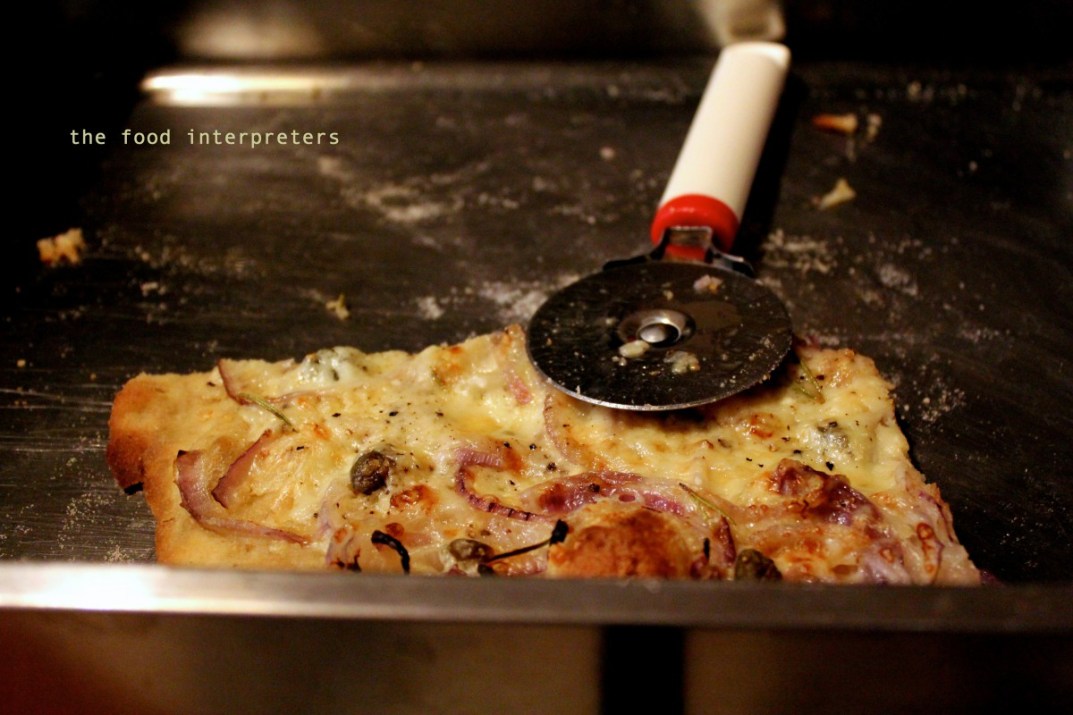
naxian pizza

naxian pizza

Topping ingredients for The “Naxian Pizza”:

For one pizza ø 38cm

  • 20og onions, very finely sliced
  • 150g Gruyère of Naxos, grated
  • 2 Tbsp parmesan cheese, finely grated
  • 1 Tbsp capers
  • 1 Tbsp fresh rosemary leaves
  • black pepper
  • 1Tbsp extra virgin olive oil
  • 1 pinch sea salt

In a bowl combine the onions with the olive oil and the salt. Let the onions in the marinade for 15 minutes, then lay them evenly on the pizza base, leaving a 1cm margin around the edges.

Scatter over the capers, the gruyère of Naxos and the parmesan .

Sprinkle with the rosemary and add a generous amount of freshly ground black pepper.

Slide the pizza on the stone** and bake for about 5-7 minutes.
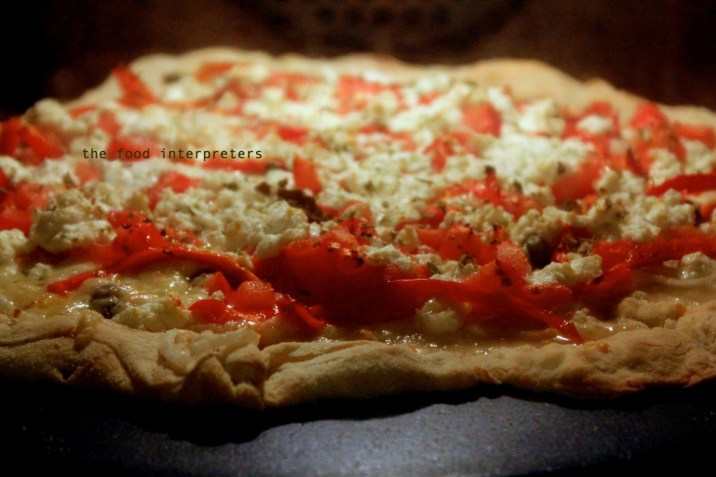
greek style pizza

greek style pizza

Toppings for the “Greek style Pizza”:

For one pizza ø 38cm

  • 100g onions, very finely sliced
  • 50g red bell pepper, sliced
  • 50g green bell pepper, sliced
  • 100g cherry tomatoes, sliced
  • 80g gruyère, grated
  • 120g feta cheese, crumbled
  • 1 Tbsp capers
  • 1 Tbsp Kalamata olives, pitted and sliced
  • 1 pinch dried oregano
  • 1 Tbsp extra virgin olive oil
  • 1 pinch sea salt

In a bowl combine the onions with the olive oil and the salt. Let the onions in the marinade for 15 minutes, then lay them evenly on the pizza base, leaving a 1cm margin around the edges. Scatter over  the red and green sliced peppers, the capers, the olives, the gruyère and the crumbled feta cheese . Arrange the sliced cherry tomatoes and sprinkle with the dried oregano.

Slide the pizza on the stone** and bake for about 5-7 minutes.

*If you do not use a pizza stone, preheat the oven to 200ºC, place the pizza on a baking tray lined with baking parchment and bake for about 15 min.

** This can be tricky. You may need the help of a spatula to guide the crust onto the heated stone.

Jam Tartlets

We always have some leftover pastry dough in our freezer after baking tarts.

This is our favorite way to use it.

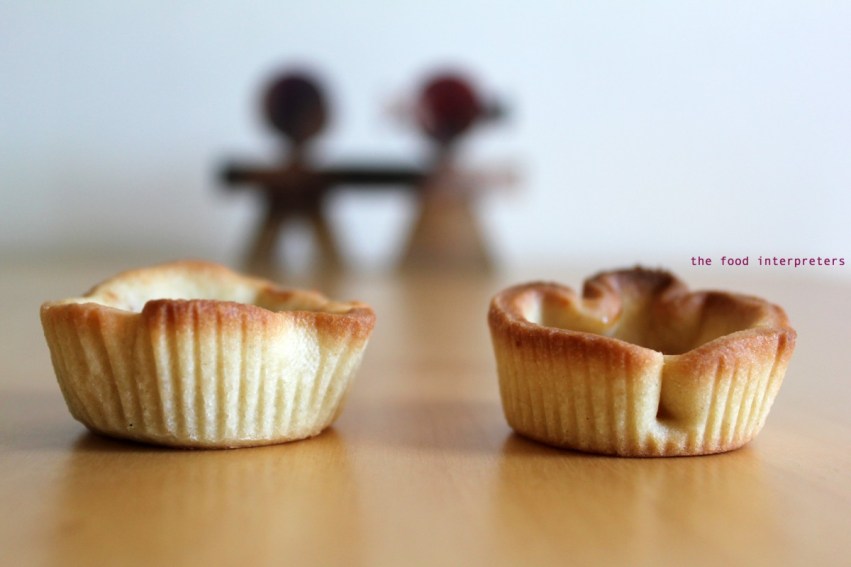
Roll out the leftover pastry on a lightly floured surface until approximately 3mm thick. Cut circular shapes with a cookie cutter . Put each circle to a cupcake tin, lined with paper cases.

Refrigerate for 15 minutes.

Preheat the oven to 180ºC.

Add a teaspoon of jam or marmalade -we use orange marmalade or plum jam- to each case and bake for about 10 minutes.

IMG_4200 copy